The Academy of DungeoneeringStory games for working teams

The game master

Their best villain, and their biggest fan.

Mark Calleja has sat behind the game master's screen for thirty years. His current table has met every week since 2020.

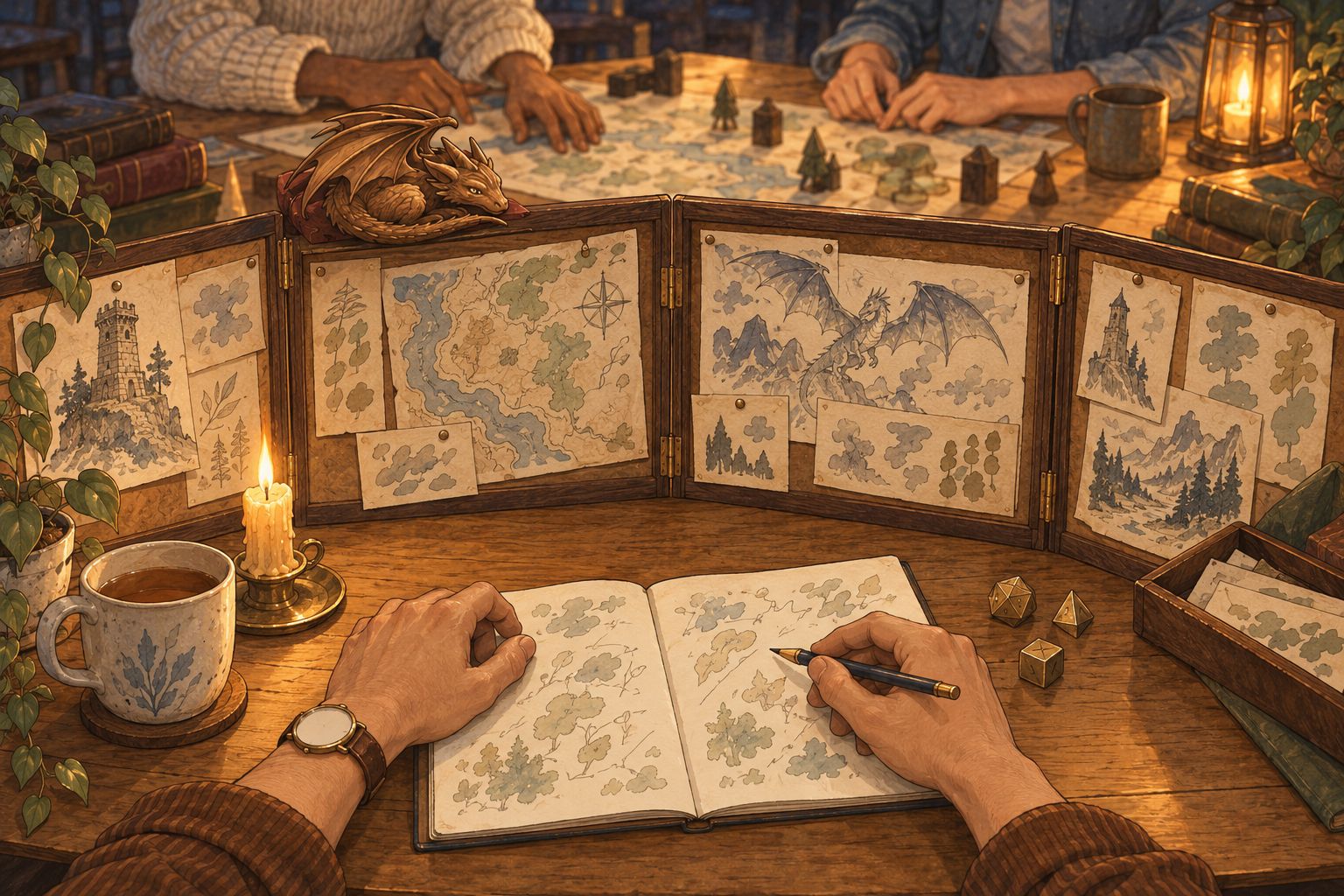
Ink-and-watercolour drawing from the game master's seat: an open folding screen covered in pinned notes and sketches, a notebook and pencil, dice, tea and a candle, with a small carved dragon asleep on top of the screen and players' hands on a map beyond it.
If the dragon never wakes up, it isn't a dragon. It's furniture.

The job

The only person at the table who can't lose.

The game master writes the world. One sentence could end everyone's evening, and another dragon is only a page away. So winning was never the point. The point is next week, when the same people want to come back.

I bring the world, its people and the challenges in your way. You bring your characters, their resources and the ideas nobody else would have thought of. Then we find out what happens.

The game master can win whenever they like. So winning was never the job. The job is making it hard enough to matter.

Mark Calleja

We make the story together

Your decisions shape the route.

I bring situations, you bring the plan

I prepare situations to explore and problems to solve. You might negotiate with someone I expected you to avoid, use an item in a way I hadn't considered, or abandon the first plan because somebody noticed what the rest of the table missed. That's part of the game. I respond to what you do, and the story develops through the conversation between us.
A different job at the same table

The game master describes the world, plays its inhabitants, guides the rules and keeps the session moving. The players decide what their characters attempt and how they work together. I can play a convincing opponent while cheering on the people trying to get past them.

Too hard, too easy

The narrow road between the two.

Too hard

People run. If it keeps happening, they stop trying. The clever plan stops arriving, and the quiet player who was about to try something brave decides not to.

Too easy

It's lovely for about forty minutes. Nothing costs anyone anything, so nothing sticks, and a month later nobody can tell you what happened.

Too hard, and they leave. Too easy, and they never really arrive.

Fair rules, real consequences

A challenge matters when the outcome is still uncertain.

The rules give decisions weight

When an outcome is uncertain and the game calls for it, we use its mechanics to resolve the attempt. That often means rolling dice. I explain the relevant rule and help you understand your options. Agreed rules and fair judgement give the table a reason to trust what happens. You choose what to attempt; we discover how it turns out.

Failure changes the problem

A failed roll might alert a guard, use up a resource, close an easy route or leave you with a difficult choice. The story carries on. Your group gets to respond, recover and come up with another approach.

Reading the table

The real job is watching faces.

Who's leaning in. Who's gone quiet. Whose idea hasn't been heard yet. How long it takes someone to say what their character does: fast means excited, slow means nervous.

Then I adjust the pace, the explanation or the size of the problem. The guard is a little more tired than planned. The reinforcements don't come. The clue turns up in the room the team actually searched.

I change the size of the problem. I never change who solves it.

Everyone can take part

You can speak in character or describe what your character does. Voices and acting are optional.

Before play, we discuss what should stay out of the story. Anyone can skip a scene without giving a reason.

For horror games, we agree the tone, themes and approach to character death beforehand, including whether a character's death could leave a player watching the rest of the session.

What that means for your team

A story hard enough to matter and fair enough to win.

For a team-development session, I explain before play what I'll be watching: how the team shares information, makes decisions, handles disagreement, makes room for different voices and adapts when a plan changes. Then I cheer you on the whole way.

The debrief gives the team a chance to decide whether anything from the game connects with how it works elsewhere. A game shows how people played that game. Your team helps establish what, if anything, it says about work.

Behind the screen

Mark Calleja.

  • Thirty years running tabletop games, with a weekly table since 2020.
  • Over a decade designing game-based learning, for groups from pre-schoolers to postgraduates.
  • Co-founder of HackLabUK.
  • Two previous TEDx talks, at King's College London and Anglia Ruskin University.

Carry on after the first adventure

If your group wants to keep playing, I can help you establish a campaign and hand it over to a GM from your own group. Your GM can also book coaching on preparation, rules, pacing or responding to unexpected ideas. Start a campaign

Further viewing

For another game master's take on collaboration, player choices and uncertain outcomes, watch Brennan Lee Mulligan with Garth Marenghi in Skull Flusher 2.

Book a table

Pull up a chair.

Email us with your group size, two or three possible dates, and whether you'd like to play in person or online.

For in-person sessions, tell us the location and whether you have a venue or would like us to arrange one. Travel is included in Cambridge and London. Additional travel and venue costs are agreed before booking.

hello@academyofdungeoneering.com

Open your email app

Explore the games · Start a campaign

Need to convince someone first? Here's a note you can send

The Academy's house dragon: a small dragon curled asleep on a stack of old books beside a lit candle, one eye half open.